
In this post we look at the STDC framework (See-Think-Do-Care) and how to use it to plan the marketing strategy of your project and company. We answer the questions: How do you start with the STDC framework? How do you work with the STDC framework? How do you plan and set up a marketing strategy with STDC? How do you prepare a marketing plan in STDC? How do you define audiences, content and marketing in the STDC framework? And many more. So let’s get to it.
Updated: 26 August 2019
Some things have to be carved in stone, which is why we are updating this article based on our experience with clients and with using the framework on internal projects.
Usability of the Framework and Introductory Thoughts
It is necessary to realise that the framework alone will not save the marketing of your company or project, because you still have to define and come up with the content and the customer yourself. It will, however, help you do everything in a well-thought-out procedure, and if you use the services of a consultant who really knows the framework, you can manage it very efficiently. The STDC framework and the workbooks tied to it that we have prepared for you form the basis of the marketing methodology we stand behind at Archetix. You can of course build everything yourself without our involvement, and that is why this article exists. Know, however, that it is not a simple task and everything stands and falls on your consistency.
Some people may even use the STDC framework, whose centrepiece is the customer and their experience with our products and services, without knowing that it is a marketing framework or procedure at all. The main benefits therefore include an easy understanding of the subject and a clarification of terms and impressions (see the individual STDC phases).
As Markéta Kabátová also points out, the framework has many shortcomings – for example it does not tie in with company goals, does not address product and service design, and does not show a clear way forward. But we have thought of that, and so we offer further supporting worksheets that turn the STDC framework into a truly functional methodology for managing a company’s marketing.
To read how the STDC framework (in full, the See-Think-Do-Care framework by Avinash Kaushik) helps develop your company’s marketing, see our previous article STDC Framework – Content, Marketing, Measurement.
This post is based on experience from working with our clients and on STDC (See-Think-Do-Care) framework trainings that we have repeatedly delivered for the public and for our clients. If you are interested in training or have further questions, don’t hesitate to contact us.
We regularly train people in creating a marketing strategy based on STDC. If you are interested in training, leave us your contact at [email protected].
The STDC Framework – the Basic Idea (See-Think-Do-Care)
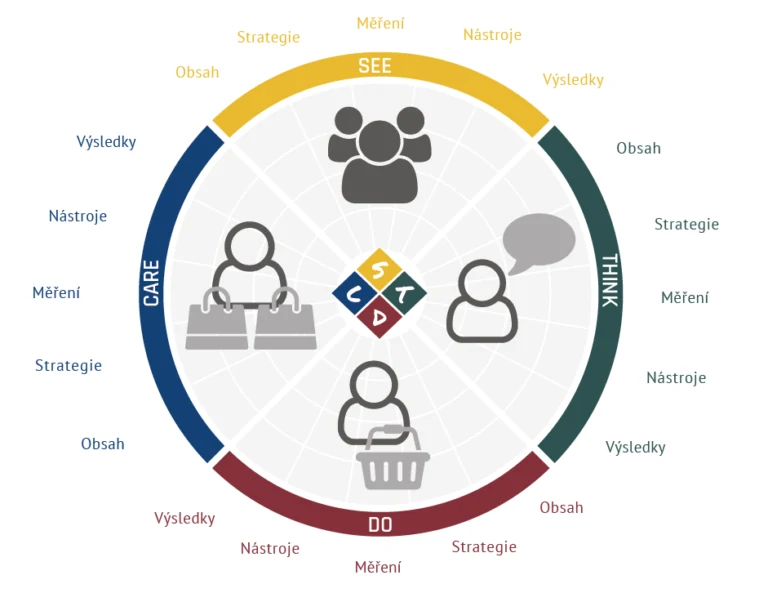
The key idea of the framework, conceived by Avinash Kaushik, a guru of digital marketing and analytics, is the definition of 4 key areas through which a company’s business goals are fulfilled, and the division of all customers, from the company’s point of view, into 4 phases of the purchase process (See-Think-Do-Care).
The 4 key areas are audience, content, marketing and measurement.
An audience is a clearly defined target group of customers to whom I deliver my content.
Content determines what I inform customers about, what interests them and what they are dealing with.
Marketing covers the specific marketing strategies and activities through which I get my content to the given audience.
Measurement is then the key point of the whole methodology, where I evaluate my marketing activities against defined metrics, compare them with the plan and determine future development. I can only manage what I measure.
The 4 phases of the purchase process are named after the English words See, Think, Do and Care – translating the STDC framework into Czech seems problematic to us, and like other experts in the Czech marketing pond we will stay with the English words See-Think-Do-Care or the abbreviation STDC. The rest of the STDC framework we describe in plain terms, so it should be no obstacle to understanding it fully.
See-Think-Do-Care can be described as the phases of the purchase process. The long-term purpose is to move customers gradually from one phase to the next.
The See phase is the largest addressable relevant audience in relation to my company/project and its products and services.
Customer needs in this phase: None. This group of customers consciously has no needs. We can, however, influence them deliberately and move the given customer into the Think phase. A typical example is a washing machine – everybody has one. They only look for a new one when the old one breaks. Why not inform them that modern washing machines save a large amount of water and electricity and are gentler on our clothes? That prompts the customer to think about the product and moves them into the Think phase.
The Think phase contains the largest addressable relevant audience with purchase intent. It is therefore the part of the audience from the See phase that is to some extent thinking about the products and services I offer.
Customer needs in this phase: Information. This customer is looking for information, is at a certain stage of decision-making, and may be interested in how to choose a product, what parameters it has, what the trends are and so on.
The Do phase contains the largest addressable relevant audience with current purchase intent. It is again part of the previous audience, for whom the key point is that they are buying right now and satisfying their needs.
Customer needs in this phase: A convenient purchase. The customer wants a quality solution at a suitable price.
The Care phase contains your customers who have bought or used your products or services twice or more. The logic behind “twice” is that these are really the customers who are happy with your products.
Customer needs in this phase: Care. Something extra. A surprise. What would a relationship be without surprises?
Putting these two parts together gives us the following scheme, where for every phase we define the audience, content, marketing and measurement.
Now I recommend that you download our worksheet for creating the STDC framework. You can fill it in electronically or print it and fill it in by hand, as you prefer. It will serve as the first step towards the strategic building of your marketing and give it meaning.
Download the STDC framework worksheet
Step 1 – Defining the Audience
The first step that awaits you when working with the STDC framework is to name your target audiences. So let’s fill in the Audience column in the worksheet. Here you start from the definitions of the individual phases and try to describe them by key characteristics in relation to your company/products. Use the following examples as inspiration.
Guiding questions for the individual phases can help you too.
See – What is the broadest relevant audience I can reach regardless of purchase intent? What audience uses or comes into contact with our products and services?
Think – What situations may the audience be dealing with in relation to my products and services? When will we know they are moving towards becoming my customers? What is key for them to start thinking about my products or services?
Do – What does the audience do when it decides to get my product/service?
Care – Is there a specific solution/activity that my customer should buy/do repeatedly? If my product/service is one-off, how do I know they are my customer? Do they use further services/servicing? Do they buy further extensions/personalisations of the products?
For illustration we will use the example of the shoe company Baťa. Its definition of audiences might look as follows. The next step could be validation with colleagues or across the company.
Step 2 – Defining the Persona
To refine the audience, the definition of personas follows, so-called avatars that represent my ideal customer. To it I then relate all content and marketing activities. We recommend defining at most 3 personas, as you cannot manage more of them sensibly. How we define personas at Archetix we will look at in the next post. A sample template can be very useful.
Download the persona template
A different style of persona definition may suit each company, for example one that focuses more on the socio-demographic definition of customers or, on the contrary, on their behaviour, attitudes and so on.
Step 3 – Existing Marketing Strategies
At this stage we recommend that our clients take a step back and think about the marketing activities you carry out.
Quite often it happens that already now the established order, and the way the company thinks about marketing and its customers, change completely. It usually comes to the surface that the company completely forgets about its existing customers.
Often nobody thinks about what precedes the purchase (that is, the Think phase), what the customer is thinking about, what situation they are in, what they are doing, and whether I can help them in any way.
A classic example is also overexploiting marketing in the Do phase, that is, pushing pointless content and campaigns across the board at all customers who have no interest in our products at that moment.
So try to think about the following questions:
- What marketing activities have you carried out in the last six months?
- How much time and money did they cost you and what were their benefits?
- Do you make full use of all the phases, or do you forget about some and lose customers as a result?
- How have you defined customers so far? Where is the biggest difference?
Step 4 – Content Strategy
Let’s now return to the STDC framework you downloaded. We are going to fill in the Content strategy column.
By now we know who our customer is and how we define them. We also have customer personas prepared and therefore a relatively clear idea of who is and who is not our customer.
We have the customers separated into the individual phases of the purchase process and now we are going to work out what information we will offer them in the given phase. Although content may overlap between phases, one of them will always be primary.
Having trouble coming up with content for your customers? The following questions may guide you:
- What do people in the given purchase phase want to know?
- What are their needs?
- What can we offer them?
- Will the audience care about the given content?
- Will my content influence progress to the next phase?
- What is our unique value for the customer?
- Why am I telling them AB and XY?
- How do I want to build our company’s brand?
- How do I communicate it?
- What form of message do I use?
You will probably arrive at a content strategy that may look, for example, like this. We continue here with the example of the shoe company.
Don’t know what to do about further content? Involve other employees and colleagues. Look at the competition. Follow trends.
Step 5 – Marketing Strategy and Marketing Channels
After the content strategy comes the plan of the marketing strategy, including the channels you will use for the given marketing activities. Here we return to the reflection in point 3).
First of all, you place your current activities into the framework.
We recommend writing the marketing strategies out horizontally and drawing the channels vertically across all the phases that use them.
The result may look like this, for example. The naming of the strategies and the level of detail of their description depend on your company’s habits. The strategies shown below serve rather as guidance, but they cannot be called strategies in the true sense of the word. We will look at planning marketing strategies in the next post.
It may happen that you are left with activities that belong nowhere. They may be activities that don’t address your customers at all or don’t fit into any phase. It would be advisable to eliminate or adjust these activities.
In cooperation with colleagues, specialists, your advertising agency or a consultant you can then come up with further ways to reach your customers exactly where and exactly how it makes the most sense.
Step 6 – Measurement Strategy
The key step for making meaningful use of the STDC framework, or of any evaluation of marketing effectiveness in general, is measuring it. Here online analytics tools and advertising systems, which offer a range of metrics already in the standard setup, make everything much easier. For most companies starting to manage their marketing they will be sufficient.
When you look deeper, however, you find that some metrics are less informative or misleading. Either way, it is key to derive them correctly from the company’s business goals. We will get to this topic in the next post, which will be devoted precisely to building a measurement strategy, an essential step for developing marketing in the future. I can only manage what I measure.
To build a measurement strategy you can use the measurement strategy worksheet. Use the metrics you now know or use, or be inspired by one of those below. The choice of metrics and the form of working with digital analytics depend on how analytically and marketing-wise mature your company is, and how much you are willing to invest in consultations.
Download the Measurement strategy worksheet
Conclusion and What Next?
You now have an STDC framework that can be used as a basis for creating a marketing methodology and a marketing management system in your company. It is necessary to mention that the STDC framework is not static; on the contrary, the development and continuous updating of the STDC framework are absolutely key for the development of the company. You derive your marketing procedures, processes and methodology from the STDC framework. You may even get into a situation where it will be appropriate to build partial STDC frameworks for individual products, services or projects.
You are at the beginning of a beautiful but long journey that will bring results in the form of achieving your dream business goals.