
For years, advertising meant Google, Meta and maybe a bit of Criteo, Reddit or TikTok. Then people started asking ChatGPT what to buy, which tool to choose and which supplier to trust. And since this summer, brands can be part of that answer: ChatGPT Ads are now available in 31 European countries.
The numbers explain why everyone is suddenly talking about it. OpenAI reported a $100M annualised run rate six weeks after the first US pilot in February, and passed a billion dollars by the end of August. Few ad platforms have ever scaled that fast.
It is a new channel with people who are actively looking for a solution, often right before a decision. Here’s the catch nobody puts in the press release: ChatGPT Ads optimise for the conversions you send them. No pixel, no Conversions API, no learning. Bad data, bad learning. And a campaign that looks like it doesn’t work – even when it does.
No code and no step-by-step tutorial in this article. Instead, you’ll get what to check, what to ask your developer or agency, and where the money usually leaks.
Summary
- ChatGPT Ads are open in 31 European countries since August 2026. Ads are shown to Free and Go users; Plus, Pro and Enterprise stay ad-free.
- The pixel alone is not enough. Ad blockers, rejected cookies and browser restrictions hide part of your conversions. The Conversions API sends them from the server.
- Pixel + Conversions API without deduplication = double revenue in reports. Every order is counted twice and the campaign looks twice as good as it is.
- Send only the conversion that makes you money. If newsletter sign-ups count the same as orders, the algorithm will happily bring you newsletters.
- If Google Ads and Meta are measured well, most of the work is done. The data layer and server-side tagging can be reused.
Why Should You Care About ChatGPT Ads?
OpenAI started testing ads in ChatGPT at the beginning of 2026. In May, a self-serve Ads Manager arrived in the US together with the Measurement Pixel and the Conversions API, and in June OpenAI added conversion-optimised campaigns. In August, ChatGPT Ads expanded to 31 European markets, including Germany and Poland.
Ads are shown to users of the free and Go plans, next to the answers they ask for. That is a very different moment than scrolling a social feed: the user is in the middle of solving a problem. For many e-shops and B2B companies, that is exactly the moment they want to be visible.
Early adopters have one advantage that disappears quickly: less competition and more room to learn. But only those who can measure the results will actually learn something.
| When | What happened |
|---|---|
| February 2026 | Ad pilot for selected advertisers in the US |
| March 2026 | $100M annualised revenue six weeks after launch |
| May 2026 | Self-serve Ads Manager, Measurement Pixel and Conversions API |
| June 2026 | Campaigns optimised for conversions |
| August 2026 | 31 European countries, $1bn run rate |
Pixel and Conversions API: What Each of Them Does
Measurement Pixel
The pixel is a JavaScript code on your website. When someone comes from an ad, it picks up OpenAI’s attribution identifier from the URL, stores it in a first-party cookie and sends events such as a viewed product, an added item, a completed order or a submitted form. If you have ever set up a Meta pixel, the principle will feel familiar.
The weakness of every browser-based measurement is the same: ad blockers, browser restrictions on cookies, users who reject consent and orders completed outside the website. Part of your conversions will simply never reach the platform.
Conversions API
The Conversions API sends conversions directly from your server (or from a server-side tagging container) to OpenAI. It is more reliable, it can include data the browser doesn’t know (for example, the final order value after cancellations, or a lead that turned into a deal in your CRM), and it is far less sensitive to what happens in the user’s browser.
Why you want both
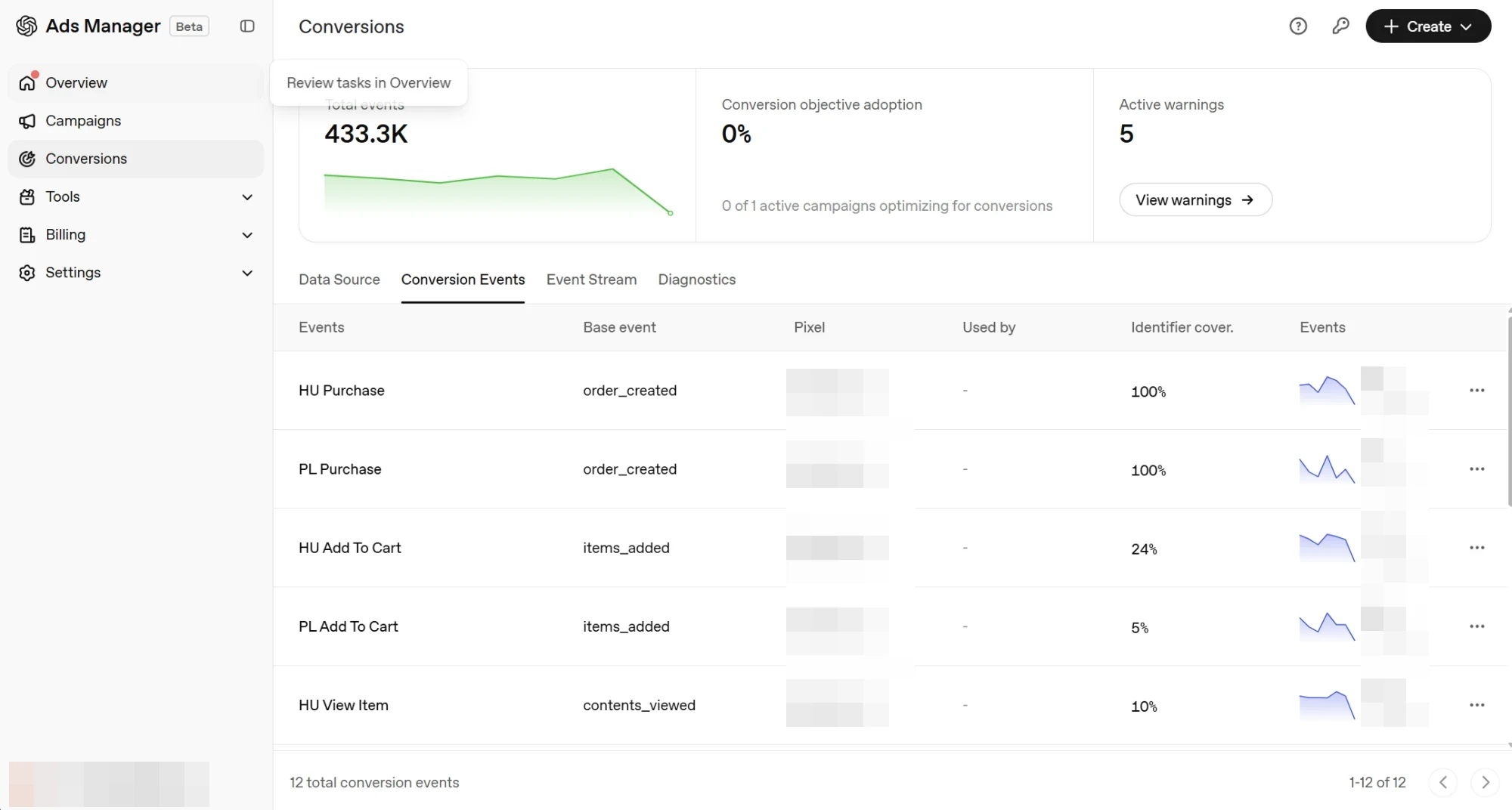
The recommended setup is hybrid: the pixel and the Conversions API send the same events and OpenAI deduplicates them, so each conversion counts only once. It sounds simple. In practice, this is exactly where most implementations quietly fail – and nobody notices until the numbers stop making sense.
5 Mistakes That Quietly Burn Your Budget
None of these shows a red warning. The ads run, the dashboard shows numbers, and you make decisions on data that isn’t true.
1. The click identifier gets lost on the way
OpenAI adds its own parameter to the landing page URL. A redirect, a cookie banner that reloads the page or a plugin that “cleans” URLs – and the conversion can’t be linked to the ad anymore. What to do: click your own test ad and check that the parameter survives all the way to the thank-you page.
2. Every order counts twice
Pixel and Conversions API send the same purchase. Without a shared event ID, OpenAI can’t tell they are the same order. Result: double revenue, double ROAS, and a budget decision based on fiction. What to do: compare conversions in Ads Manager with orders in your back office for the same days.
3. Consent: either illegal, or blind
In the EU, the pixel has to wait for the user’s consent. Connected badly to the cookie banner, it either fires without consent (legal risk) or never fires at all (zero data). What to do: test both cases – accept and reject – and check what really leaves the browser.
4. Customer data that doesn’t match
Emails and phone numbers are sent hashed, and they have to be normalised exactly as OpenAI requires. One extra space or a missing country code and the match rate drops – silently. What to do: ask how the data is normalised before hashing. If the answer is “we just hash it”, there’s work to do.
5. Optimising for the wrong conversion
If newsletter sign-ups and orders are both “conversions”, the algorithm will chase the cheap ones. You’ll see 200 conversions a month – and 40 orders. What to do: send everything you want to analyse, but optimise campaigns only for the action that makes money.
Checklist: What to Ask Your Developer or Agency
You don’t have to understand the implementation. You just have to ask the right questions. If any answer is “not sure”, it’s worth a second look:
- Which events do we send to OpenAI, and which one do campaigns optimise for?
- Do the pixel and the Conversions API share an event ID for deduplication?
- Does the click identifier survive redirects and the cookie banner?
- What happens when a user rejects cookies – and when they accept them?
- How are emails and phone numbers normalised before hashing?
- Do conversions in Ads Manager roughly match orders in the back office?
- Can we compare ChatGPT Ads with Google Ads and Meta in one report?
How We Do It at Archetix
We don’t stick another script onto your website. We connect OpenAI to the measurement you already have: data layer, Google Tag Manager, server-side tagging and consent. We map your business goals to OpenAI’s events, test deduplication and consent before launch, and put ChatGPT Ads into the same report as your other channels. With server-side tagging already in place, it’s days, not weeks.
Is It for You? A 30-Second Test
| Go for it if… | Wait if… |
|---|---|
| Your customers research before buying (higher order value, B2B, SaaS, travel, finance) | You can’t say how many orders came from Google Ads last month |
| Google Ads or Meta already work for you and you want another performance channel | Your budget barely covers the channels that already work |
| Your conversion tracking is reliable, or you’re ready to fix it first | Nobody owns measurement in your company |
If you’re in the right column, start with measurement. A new channel won’t fix data you can’t trust – it will only add more of it.
Get Ready Before Your Competitors Do
ChatGPT Ads are at the stage Google Ads and Facebook Ads were in many years ago: the rules are still being written, and those who learn first gain an advantage. We will be happy to prepare your measurement so that your first campaign produces data you can actually rely on.
Frequently Asked Questions
Can I advertise in ChatGPT in Europe?
Yes. Since August 2026, ChatGPT Ads are available in 31 European countries. Ads are shown to users of the free and Go plans; Plus, Pro and Enterprise remain ad-free.
Is the pixel enough, or do I need the Conversions API too?
The pixel alone works, but it misses conversions blocked in the browser and those that happen outside the website. For campaigns optimised for conversions, we recommend the combination of the pixel and the Conversions API with deduplication.
Can I use Google Tag Manager?
Yes. The pixel can be deployed through Google Tag Manager, and the Conversions API through a server-side GTM container. If you already use GTM for GA4 and other platforms, the existing data layer can usually be reused.
Is it GDPR compliant?
The pixel supports consent management, so it only sends data after the user agrees. Customer data sent to the Conversions API is hashed. The connection to your cookie banner and your privacy documentation still has to be set up correctly – that is part of every implementation we do.
How long does the implementation take?
With a working data layer and GTM, the pixel takes a few days including testing. The Conversions API depends on whether you already have server-side tagging. If you do, it is days; if not, we will prepare it as part of the project.
Sources: OpenAI Ads developer documentation, OpenAI: ChatGPT Ads expands across Europe, PPC Land: ChatGPT ads passed a $1bn run rate, eMarketer: $100M annualised revenue.