
Is offline dead these days? Most companies are moving more and more of their budgets online. Where will it end? Will we move completely online? Let’s take a look at how this topic connects with a brief from Real Simulator!
PPC ads, social media, video ads – these are all recent trends, and it really looks as if “outdated” offline channels are gradually losing importance. The question is whether it isn’t the other way round. Isn’t it easier today to break through with good old flyers, when there is so much competition in the online environment? We would love to know the answer, but it is not that simple. One of the main reasons is that, compared to online advertising, offline advertising is much harder to evaluate, and its real impact on revenue is much harder to measure.
Our activities and the services we offer clients revolve mainly around online marketing, but when planning marketing strategies we never write offline off. Recently, we worked with one of our clients on promoting their product. The result was an offline campaign that brought interesting results, and we are happy to share it in this case study.
The Brief from Real Simulator
We have a great product
- A unique flight simulator built from a real aircraft cockpit. We have mastered the original instruments like no one else in the world. Thanks to this world first, we can boast the most realistic DC-9 airliner simulator in the world.
Price vs. experience
- at first glance, it may seem high
- but the price is fully in line with the experience that follows
- it is hard to communicate this experience to new customers in words, and even photos are problematic
- 99% of customers are absolutely thrilled with the experience – link to the reviews
- for the general public (non-pilots, non-gamers), it is hard to communicate how realistic the experience you get in a simulator built from a real cockpit is, because all competing simulators also claim to offer an absolutely realistic experience
Competition
- the same or a higher price
- a less realistic experience, but communicated in the same way
- lower quality of the services offered
- a better location, most often Prague
Target group
- B2B customers
- companies that order a flight experience as part of an unconventional team building or party for their employees (a flight in the simulator with a pleasant get-together in the VIP lounge)
Budget
- in the order of thousands to tens of thousands of Czech crowns
Goal
- at least 2 orders for a Christmas party
- raising brand awareness in Liberec and the surrounding area
Solution Options for Real Simulator
Online solution
- a PPC campaign, a social media campaign, videos, interviews
- I will bombard people with ads
- the customer will start comparing similar products online
- costs – I can control them very well and it is up to me how much I put in – a small share of fixed costs and a large share of variable costs; on the other hand, given the budget, I cannot get too carried away
- we can evaluate the result of the campaign clearly, specifically and easily: how many people saw the ad, how many read it and how many clicked through to an order
Offline solution
- we will reach out to at least 100 companies in the surrounding area
- we will invite them personally to a free demo flight in our simulator and, as part of it, present the options for corporate cooperation
- as the main channel, we will use good old post
- we will target the mailing at HR departments for one simple reason – if a letter is addressed to the HR department, it usually gets at least into the hands of the HR department, and there is less chance it will end up in an assistant’s or receptionist’s bin
- costs: printing 100 invitations + 100 boarding passes (tickets), 100 postage stamps, a few hours of a temp preparing the envelopes, the time spent on incoming calls from interested companies and scheduling them throughout the day, and the costs of the demo day itself
- the client does not have much experience with offline campaigns and it is impossible to predict how they might turn out
- we will keep our fingers crossed together that someone gets in touch; we don’t know whether the letter reached the right hands or how many people read it, and the only measure will be the number of people who eventually get in touch or place an order
The Result of Our Project with Real Simulator
As the article already suggests, we decided to experiment and try the offline option. So how did it all turn out?
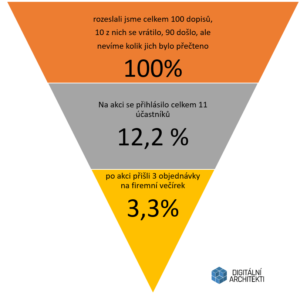
From our point of view, the campaign was a success. Out of 90 successfully sent invitations, 3 orders for a company party came in, which is a very decent result considering the costs of the campaign.
If we had launched an online campaign with the same budget, the result would probably not have been the same.
What to take away from it?
So what lessons can we draw from this case study and experience? We are certainly not saying “let’s go back to the good old offline world and forget about online.” Nor is the conclusion that “this works for this company, so it will always work for you everywhere too.”
We would, however, like to pass on a different idea. The world of marketing and advertising is growing, especially online, and it will be harder and harder to stand out in it. So don’t be afraid of change and of experiments that may seem odd at first glance. Try fresh ways of getting your product to people.
But you can only afford this if you have a smart and meaningful marketing strategy and you know that all your activities fit together and lead to a clear business goal. Only then can we talk about an experiment rather than money thrown away.
Before you launch any campaign, never forget to set a clear goal and a way to evaluate the campaign at the end. Such a campaign must then have its place within the marketing strategy and lead to meeting at least one key performance indicator (KPI).
In our case, the goal was clear: 2 orders for a company party. We managed 3, and with a minimal budget on top of that. Within the strategy, the campaign contributed to the key indicator tracking turnover.
When we prepare a new campaign with our client, it is always preceded by a number of steps, and launching the campaign itself is the easiest part. Preparing a long-term marketing strategy, from which a clear goal for the given campaign “falls out”, and then going one step further and preparing a measurement strategy for it, is the basic building block of smart marketing.
To prepare the campaign itself, we use a simple tool that we are happy to share with you at the end of this article (in Czech).