
Perhaps you have a website or an e-shop. Perhaps you invest money in advertising, social networks or content. But do you really know what is happening on your website? How many people visit it, where they come from, what interests them and why in the end they do (or do not do) what you want them to?
This is exactly where web analytics comes in.
Web Analytics Made Simple
Web analytics is a way of collecting and evaluating information about visitor behaviour on a website. Thanks to it you know what works on your website and what does not. It is not about complicated tables, but about answers to very practical questions. For example:
✔️ How many people came to the website today?
✔️ Where did they come from – Google, an ad, email?
✔️ Which page do they spend the most time on?
✔️ Where do people leave?
✔️ How many of them bought something or submitted a form?
Without analytics you are only guessing. With analytics you decide based on reality.
An Example from Everyday Life
Imagine a brick-and-mortar shop. Close your eyes and try to imagine that you do not know how many people have come into the shop and you do not know which shelf they stopped at. You also do not know what they picked up, or why they left without buying anything. This is exactly how a website works without web analytics.
Web analytics, on the other hand, lets you "see into the shop" and understand customer behaviour – only in the online world.
What Is Tracked with Web Analytics
Web analytics does not track any secret information about people. It tracks behaviour on the website, not specific individuals. Thanks to this you know how your website is really doing, not how you think it should be doing. Typically the following is measured:
- whether they performed the desired action (a purchase, a form submission, a registration),
- how many people visited the website, how many of them are new and how many are returning,
- which pages they view and how long they stayed on them,
- where they came from to the website and which source of visits pays off the most for you (organic or paid traffic).
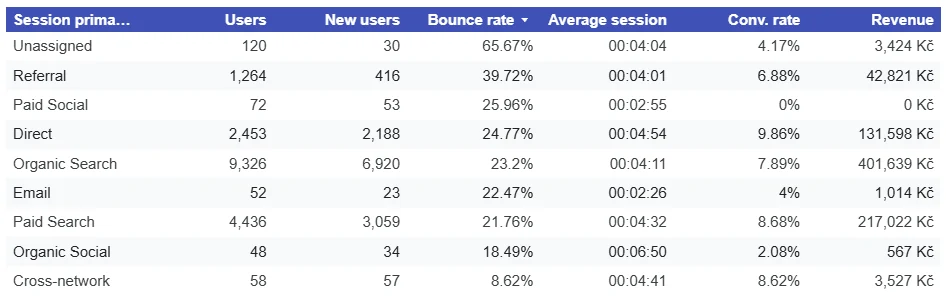
Figure: an example of a report on the source of visits, basic user metrics and overall return
Why Web Analytics Is Not Just for E-Shops
It is often said: "Only e-shops need analytics." That is not true. Web analytics is needed by company websites that collect enquiries, B2B websites with contact forms, educational portals, blogs, university websites and in fact everyone who wants to know how well their website performs.
Every website has some goal. And web analytics will show you whether visitors are really heading towards it. If you have your own blog, for example, you do not write it just for yourself, and you will most likely be interested in how many people read each article. Analytics shows you this data and more. The boundaries of analytics are very wide, and for the readership of blog articles you might be interested, for example, in the percentage of people who read to 25%, 50% or 90%, so that you can use this information to edit the article further or write other articles. Or you want to know which cities your traffic comes from, and whether your dream audience is the one visiting you.
What Is the Difference Between "Having Analytics" and "Working with Analytics"
Many websites have an analytics tool deployed. But nobody deals with the data. That is like having a speedometer in the car and never looking at it. Analytics is not a one-off thing. It is a long-term helper in decision-making. Web analytics only makes sense when you regularly follow the data and compare it over time. You look for connections and make changes based on them. This applies to any type of website. In short, analytics is not just a result, it is a process.
Typical work with analytics involves several tools, which you either master yourself or someone does it for you. These tools differ according to need, popularity, available documentation or simplicity. We mostly work with tools within Google:
– Google Tag Manager,
– Google Analytics 4,
– Looker Studio
What Web Analytics Will Bring You
Properly set up and used web analytics will help you:
- understand customers better,
- improve your website without unnecessary changes,
- save money on advertising that does not work,
- increase the number of enquiries or orders,
- make decisions with certainty, not by feeling.
You do not have to be a technician or an analyst. What matters is knowing what to look at in the data and why. Web analytics will help you understand their behaviour and build a website that makes sense to them. And when a website makes sense to people, it makes sense for your business too.
If you are interested in what is really happening on your website, web analytics is the best place to start.